
Biography
Khajeh Shamseddin Mohammad Hafiz Shirazi
Very little credible information is known about Hafiz's life. The following encapsulates what we know with a fair amount of certainty.
Birth
Sometime between 1310–1325 AD. Most probable: 1320 or 1325 AD.
Shiraz, south-central Iran.
Shamseddin Mohammad
Family
Hafiz — a title given to those who had memorized the Koran by heart, in fourteen different ways.
Khajeh Shamseddin Mohammad Hafiz-e Shirazi
Baha-ud-Din
Hafiz married in his twenties, continuing his love for Shakh-e Nabat as the manifest symbol of her Creator's beauty.
One child.
Life and times
Memorized the Koran and works of Saadi, Attar, Rumi, and Nizami.
His father died. He left school to work in a drapery shop and later a bakery.
Saw Shakh-e Nabat, a young woman of incredible beauty. Many of his poems are addressed to her.
Kept a forty-day and night vigil at the tomb of Baba Kuhi, then met Attar and became his disciple.
Poet of the court of Abu Ishak. The "Spiritual Romanticism" phase of his poetry.
Ousted from his teaching position when Mubariz Muzaffar captured Shiraz.
Re-instated by Shah Shuja. Began his phase of subtle spirituality.
Self-imposed exile in Isfahan. Poems speak of longing for Shiraz and his spiritual Master.
Returned to Shiraz and re-instated to his post.
After a forty-day vigil, attained Cosmic Consciousness, or God-Realization.
Composed more than half of his ghazals and continued to teach his circle of disciples.
Death
Late 1388 or early 1389 AD, at the age of 69.
Shiraz.
In the Musalla Gardens, Shiraz — the Hafezieh.
The Oracle
To resolve the controversy over burial, a young boy drew a random couplet — verse 7 of Ghazal 79:
With all his misdeeds, heavens for him wait.
که گر چه غرق گناه است میرود به بهشت
Hafezieh — Tomb of Hafiz in Shiraz
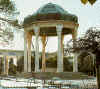
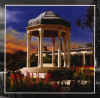
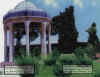
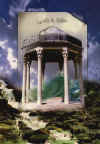
Click any photo to enlarge. Use ← → to navigate.
What others say about Hafiz
In his poetry Hafiz has inscribed undeniable truth indelibly … Hafiz has no peer!
— Goethe
Hafiz defies you to show him or put him in a condition inopportune or ignoble … He fears nothing. He sees too far; he sees throughout.
— Ralph Waldo Emerson
There is as much sense in Hafiz as in Horace, and as much knowledge of the world.
— Sir Arthur Conan Doyle
The best musician of Words.
— Edward Fitzgerald
Hafiz is as highly esteemed by his countrymen as Shakespeare by us, and deserves as serious consideration.
— A. J. Arberry
References
- Hafiz — Tongue of the Hidden, versions by Paul Smith
- The Green Sea of Heaven, translated by Elizabeth T. Gray, Jr.
- Odes of Hafiz — Poetical Horoscope, translated by Abbas Aryanpur Kashani
- Divan-e Khajeh Shamseddin Mohammad Hafiz-e Shirazi, by Mohammad Ghazvini and Dr. Ghasem Ghani